
Sponsored content · Focus on Business
Where care meets control
Barrington Times · April 29, 2026 · Page 20
The flexibility, continuity, and direct decision-making of an independently owned practice.
Open the full-size image to zoom in and read the print. The publisher’s edition requires a subscription.
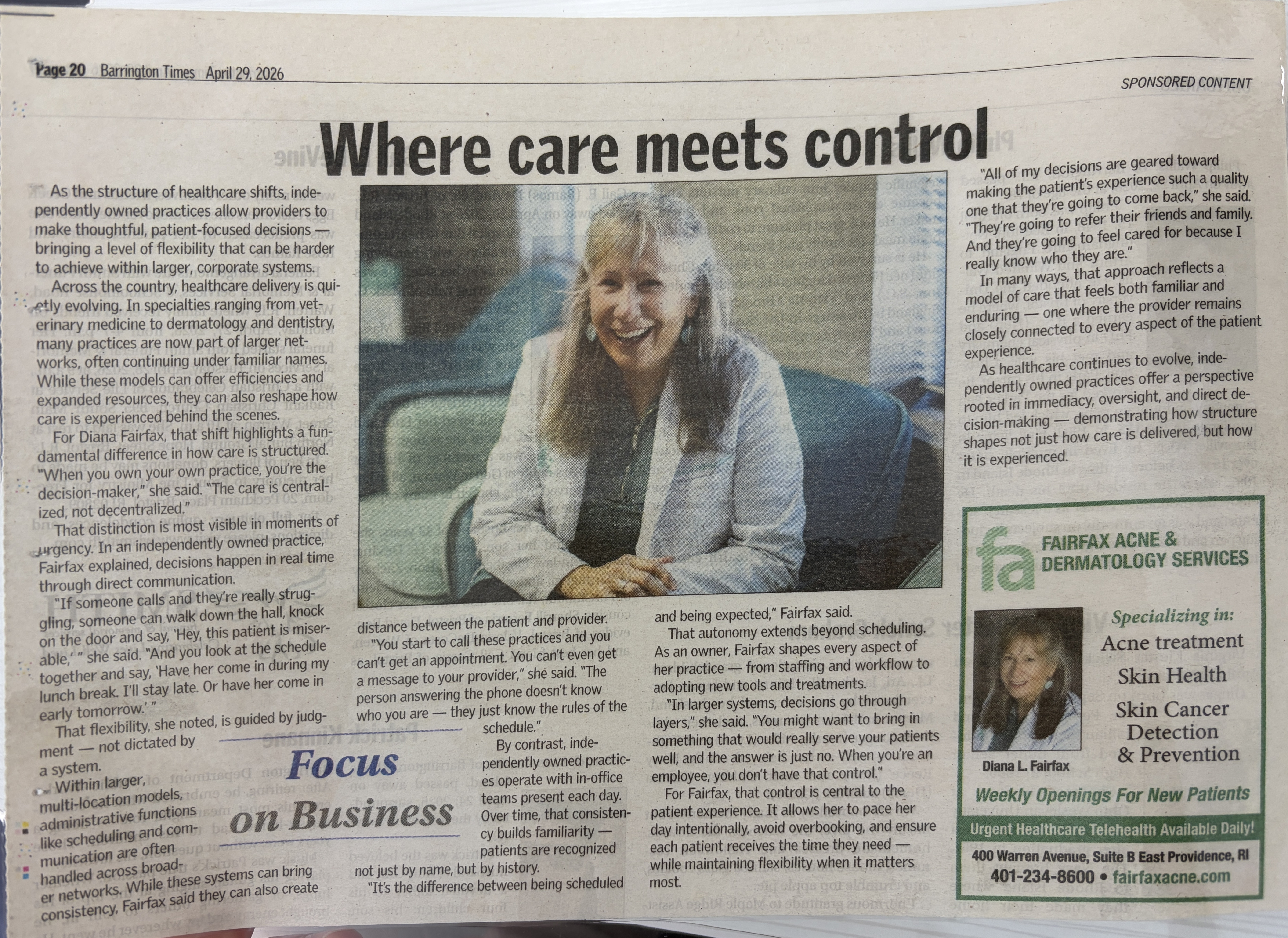
Read text transcription
Transcribed from the newspaper clipping. Statements reflect the article as published on April 29, 2026.
As the structure of healthcare shifts, independently owned practices allow providers to make thoughtful, patient-focused decisions — bringing a level of flexibility that can be harder to achieve within larger, corporate systems.
Across the country, healthcare delivery is quietly evolving. In specialties ranging from veterinary medicine to dermatology and dentistry, many practices are now part of larger networks, often continuing under familiar names. While these models can offer efficiencies and expanded resources, they can also reshape how care is experienced behind the scenes.
For Diana Fairfax, that shift highlights a fundamental difference in how care is structured.
“When you own your own practice, you’re the decision-maker,” she said. “The care is centralized, not decentralized.”
That distinction is most visible in moments of urgency. In an independently owned practice, Fairfax explained, decisions happen in real time through direct communication.
“If someone calls and they’re really struggling, someone can walk down the hall, knock on the door and say, ‘Hey, this patient is miserable,’” she said. “And you look at the schedule together and say, ‘Have her come in during my lunch break. I’ll stay late or have her come in early tomorrow.’”
That flexibility, she noted, is guided by judgment — not dictated by a system.
Within larger, multi-location models, administrative functions like scheduling and communication are often handled across broader networks. While these systems can bring consistency, Fairfax said they can also create distance between the patient and provider.
“You start to call these practices and you can’t get an appointment. You can’t even get a message to your provider,” she said. “The person answering the phone doesn’t know who you are — they just know the rules of the schedule.”
By contrast, independently owned practices operate with in-office teams present each day. Over time, that consistency builds familiarity — patients are recognized not just by name, but by history.
“It’s the difference between being scheduled and being expected,” Fairfax said.
That autonomy extends beyond scheduling. As an owner, Fairfax shapes every aspect of her practice — from staffing and workflow to adopting new tools and treatments.
“In larger systems, decisions go through layers,” she said. “You might want to bring in something that would really serve your patients well, and the answer is just no. When you’re an employee, you don’t have that control.”
For Fairfax, that control is central to the patient experience. It allows her to pace her day intentionally, avoid overbooking, and ensure each patient receives the time they need — while maintaining flexibility when it matters most.
“All of my decisions are geared toward making the patient’s experience such a quality one that they’re going to come back,” she said. “They’re going to refer their friends and family. And they’re going to feel cared for because I really know who they are.”
In many ways, that approach reflects a model of care that feels both familiar and enduring — one where the provider remains closely connected to every aspect of the patient experience.
As healthcare continues to evolve, independently owned practices offer a perspective rooted in immediacy, oversight, and direct decision-making — demonstrating how structure shapes not just how care is delivered, but how it is experienced.