
Sponsored content · Focus on Business
Why skincare advice should come from experts — not influencers
Barrington Times · February 11, 2026 · Page 25
Age-appropriate skincare, simple routines, and the value of individualized professional guidance.
Open the full-size image to zoom in and read the print. The publisher’s edition requires a subscription.
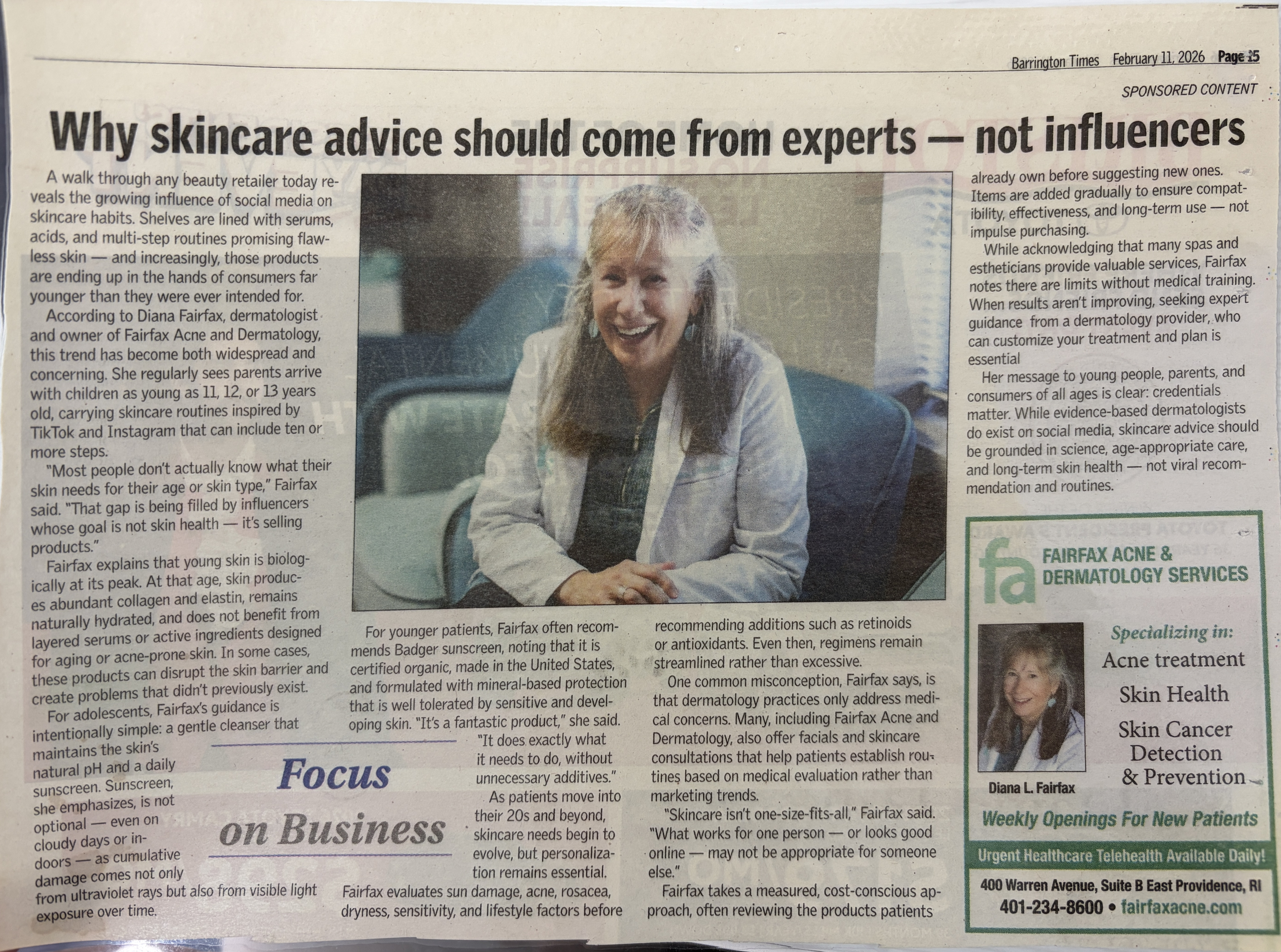
Read text transcription
Transcribed from the newspaper clipping. Statements reflect the article as published on February 11, 2026.
A walk through any beauty retailer today reveals the growing influence of social media on skincare habits. Shelves are lined with serums, acids, and multi-step routines promising flawless skin — and increasingly, those products are ending up in the hands of consumers far younger than they were ever intended for.
According to Diana Fairfax, dermatologist and owner of Fairfax Acne and Dermatology, this trend has become both widespread and concerning. She regularly sees parents arrive with children as young as 11, 12, or 13 years old, carrying skincare routines inspired by TikTok and Instagram that can include ten or more steps.
“Most people don’t actually know what their skin needs for their age or skin type,” Fairfax said. “That gap is being filled by influencers, whose goal is not skin health — it’s selling products.”
Fairfax explains that young skin is biologically at its peak. At that age, skin produces abundant collagen and elastin, remains naturally hydrated, and does not benefit from layered serums or active ingredients designed for aging or acne-prone skin. In some cases, these products can disrupt the skin barrier and create problems that didn’t previously exist.
For adolescents, Fairfax’s guidance is intentionally simple: a gentle cleanser that maintains the skin’s natural pH and a daily sunscreen. Sunscreen, she emphasizes, is not optional — even on cloudy days or indoors — as cumulative damage comes not only from ultraviolet rays but also from visible light exposure over time.
For younger patients, Fairfax often recommends Badger sunscreen, noting that it is certified organic, made in the United States, and formulated with mineral-based protection that is well tolerated by sensitive and developing skin. “It’s a fantastic product,” she said.
“It does exactly what it needs to do, without unnecessary additives.”
As patients move into their 20s and beyond, skincare needs begin to evolve, but personalization remains essential. Fairfax evaluates sun damage, acne, rosacea, dryness, sensitivity, and lifestyle factors before recommending additions such as retinoids or antioxidants. Even then, regimens remain streamlined rather than excessive.
One common misconception, Fairfax says, is that dermatology practices only address medical concerns. Many, including Fairfax Acne and Dermatology, also offer facials and skincare consultations that help patients establish routines based on medical evaluation rather than marketing trends.
“Skincare isn’t one-size-fits-all,” Fairfax said. “What works for one person — or looks good online — may not be appropriate for someone else.”
Fairfax takes a measured, cost-conscious approach, often reviewing the products patients already own before suggesting new ones. Items are added gradually to ensure compatibility, effectiveness, and long-term use — not impulse purchasing.
While acknowledging that many spas and estheticians provide valuable services, Fairfax notes there are limits without medical training. When results aren’t improving, seeking expert guidance from a dermatology provider, who can customize your treatment and plan is essential.
Her message to young people, parents, and consumers of all ages is clear: credentials matter. While evidence-based dermatologists do exist on social media, skincare advice should be grounded in science, age-appropriate care, and long-term skin health — not viral recommendation and routines.